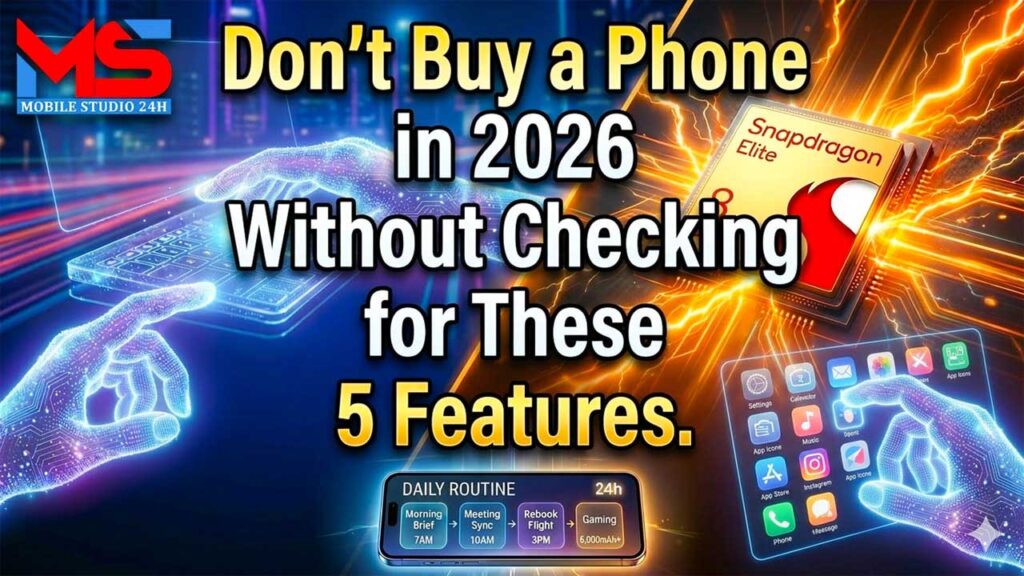
In 2026, the smartphone landscape has shifted from chasing “specs for specs’ sake” to prioritizing features that fundamentally change how we interact with our devices. If you are in the market for a new phone this year, simply looking at RAM and megapixels isn’t enough.
At Mobile Studio 24h, we’ve analyzed the latest releases—from the Samsung Galaxy S26 to the Xiaomi 17 Ultra—to identify the five non-negotiable features you must check before clicking “buy.”
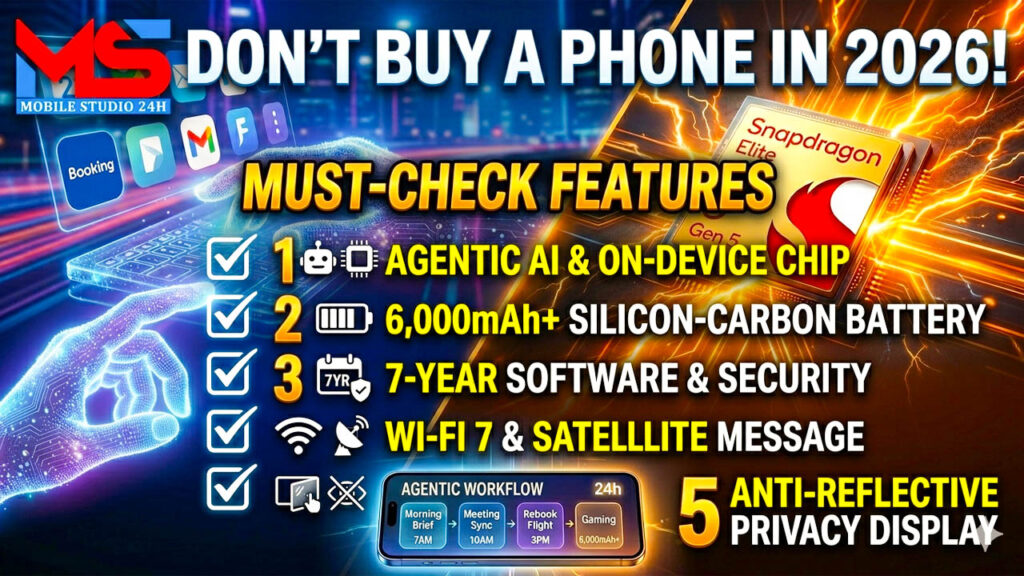
1. Agentic AI & On-Device Processing
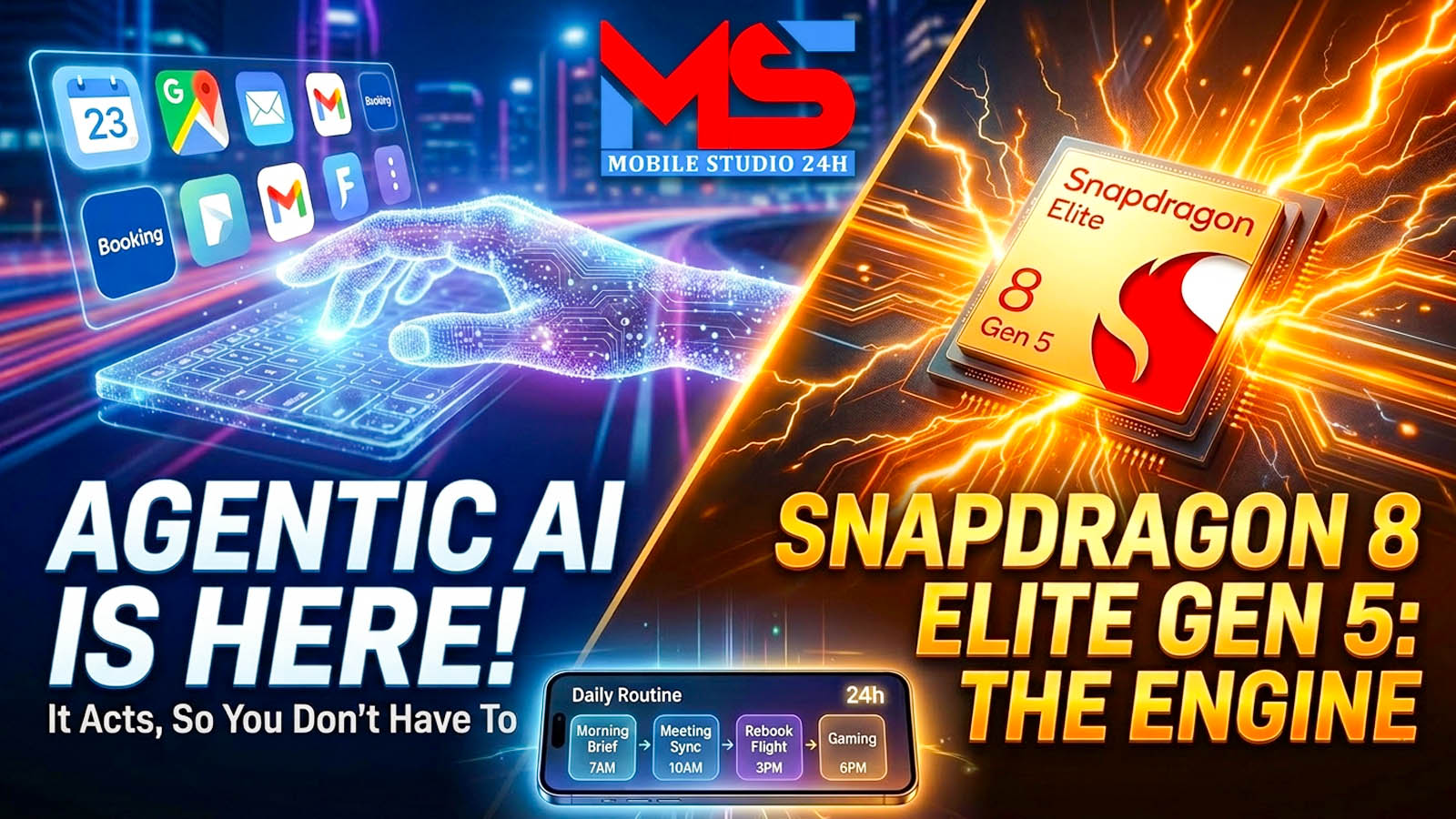
In 2026, the “smart” in smartphone has evolved. We have moved past simple chatbots to Agentic AI. An “Agent” doesn’t just answer questions; it takes action.
When choosing a phone, ensure it is powered by a chip like the Snapdragon 8 Elite Gen 5 or Apple A19 Bionic. These processors are designed for On-Device AI.
- Why it matters: On-device processing means your data doesn’t have to leave the phone to “think.” This provides better privacy, faster response times, and the ability for your AI agent to manage your calendar, book travel, or summarize meetings even when you’re offline.
- The Check: Ask if the AI features work locally or require a cloud subscription.
2. Silicon-Carbon Battery Technology
The days of the standard 5,000mAh battery are fading. In 2026, high-density Silicon-Carbon (Si-C) batteries have become the gold standard.
- Why it matters: Si-C chemistry allows manufacturers to cram more energy into a thinner profile. You should be looking for a minimum of 6,000mAh in a flagship. These batteries not only last longer on a single charge but also degrade much slower over time, meaning your phone will still have great battery life two or three years from now.
- The Check: Don’t just look at the mAh; check if it uses Silicon-Carbon technology for better energy density.
3. 7-Year Software & Security Guarantee
Smartphone prices are rising, and to justify the cost, longevity is key. Leading brands like Samsung and Google now offer a full 7 years of OS and security updates.
- Why it matters: A phone with only 2 or 3 years of support is essentially “expired” tech by 2029. Long-term support ensures your phone remains compatible with the latest apps and stays protected against new security threats. It also significantly increases the resale value of your device.
- The Check: Verify the specific update policy. “7 years of security” is not the same as “7 years of OS updates.”
4. Wi-Fi 7 & Integrated Satellite Messaging
Connectivity in 2026 isn’t just about 5G anymore. Wi-Fi 7 is now the standard for high-end home and office networks, offering speeds up to 4x faster than Wi-Fi 6.
- Why it matters: Wi-Fi 7 allows for lag-free VR/AR streaming and instant 8K video uploads. Additionally, look for Integrated Satellite Messaging. While once a niche emergency feature, it is now becoming a standard for staying connected in “dead zones” where cellular towers can’t reach.
- The Check: Ensure the device is Wi-Fi 7 Certified and supports two-way satellite communication.
5. Anti-Reflective & Privacy Displays
Display technology has moved beyond just “brightness.” The latest trend for 2026 is functional glass.
- Why it matters: Look for panels with advanced anti-reflective coatings (like those found on the S26 series) that make the screen readable even in direct sunlight without cranking the brightness to 100% and draining the battery. Furthermore, “Privacy Displays” are emerging—these allow you to toggle a mode that restricts viewing angles so the person sitting next to you on a train can’t see your sensitive messages or banking info.
- The Check: Look for “Anti-Glare” or “Privacy-on-Demand” in the display specs.
Verdict
Buying a phone in 2026 is an investment in your digital productivity. If a device lacks at least three of these five features, it may be outdated within a year. Prioritize AI that works for you, batteries that last, and connectivity that never drops.
Frequently Asked Questions
1. Is “Agentic AI” just another name for Siri or Google Assistant?
Not exactly. While Siri and Google Assistant are Reactive (they wait for you to ask a question), Agentic AI is Proactive. Using the Snapdragon 8 Elite Gen 5, these new agents can autonomously perform multi-step tasks across different apps—like booking a full travel itinerary or managing your emails—without you having to open each app manually.
2. Why should I look for a Silicon-Carbon battery instead of a regular one?
Silicon-Carbon (Si-C) technology is the biggest battery breakthrough in a decade. It allows phones to be thinner while packing massive capacities (often 6,000mAh to 8,000mAh). They offer higher energy density and faster charging speeds than traditional Lithium-ion, meaning you get two-day battery life without a bulky phone.
3. Is 8K video recording actually useful in 2026?
While few people own 8K TVs, recording in 8K is now a “pro” feature for re-framing. On phones like the S26 Ultra, the software uses the 8K resolution to allow you to crop into a perfect 4K shot with extreme stability. It’s less about watching in 8K and more about the extra “zoom” and editing flexibility it provides.
4. How important is Satellite Connectivity if I don’t go hiking?
In 2026, it’s becoming a “peace of mind” feature. Beyond emergency SOS, many flagships now support Two-Way Satellite Messaging for daily use. If you live in an area with spotty cell coverage or travel internationally, it ensures you are never truly “off the grid,” even when there is no 5G tower in sight.
5. Do I really need a phone with 7 years of software updates?
Yes, especially if you plan to resell your phone later. A 7-year update guarantee from brands like Samsung and Google ensures your device remains secure and compatible with the latest AI apps until 2033. This dramatically increases the long-term value and lifespan of your investment.
Disclaimer
Disclaimer: This guide is based on current 2026 industry standards, manufacturer specifications, and expert research. Actual feature availability may vary by region and specific mobile carrier configurations.