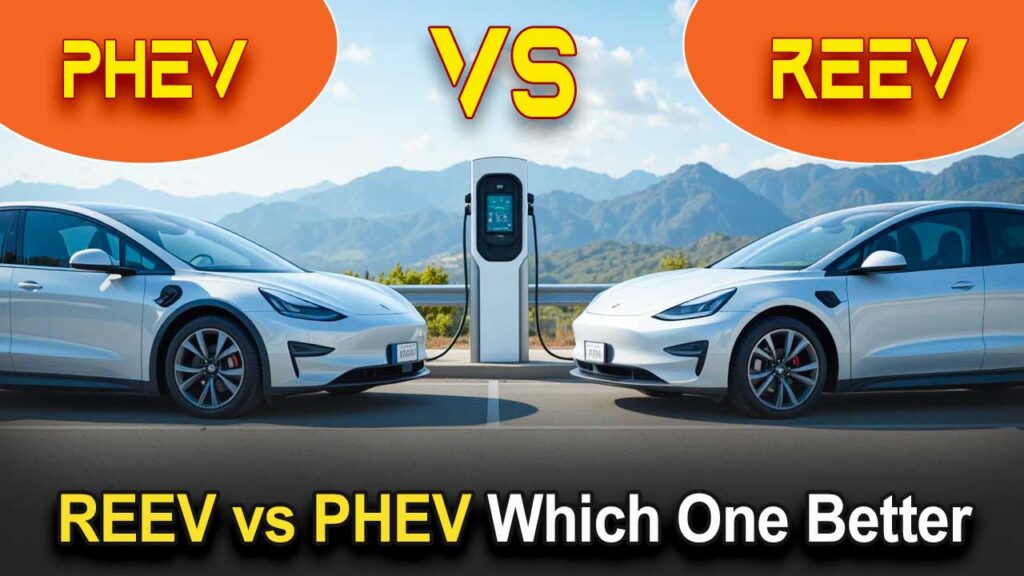
At Mobile Studio 24h, we receive hundreds of questions about PHEVs (Plug-in Hybrid Electric Vehicles) and the increasingly popular REEVs (Range-Extended Electric Vehicles). While they both use a plug and a gas tank, their internal “DNA” is completely different.
This 1,000-word guide breaks down the engineering, the costs, and the real-world performance to help you decide which is better for your global lifestyle.
1. The Engineering: How They Actually Work
The fundamental difference between these two is how the gasoline engine interacts with the wheels.
The PHEV: The “Dual-Mode” Hybrid
A PHEV is a Parallel Hybrid. It has two separate power sources: an electric motor and a gasoline engine. Crucially, in a PHEV, both the motor and the engine are mechanically connected to the wheels.
- How it drives: At low speeds or short distances, it behaves like an EV. However, when you accelerate hard or exceed a certain speed, the gasoline engine “kicks in” and physically turns the wheels alongside the motor.
- The Complexity: Because it has two full powertrains and a complex transmission to manage them, it is mechanically very intricate.
The REEV: The “Electric-First” Series Hybrid
A REEV (also known as an EREV) is a Series Hybrid. In this setup, only the electric motor drives the wheels. The gasoline engine has no physical connection to the tires.
- How it drives: The engine acts purely as a portable generator. When the battery gets low, the engine turns on to create electricity, which then powers the motor or recharges the battery.
- The Experience: It feels like a 100% electric car 100% of the time—quiet, smooth, and instant torque—regardless of whether the engine is running.
2. Range and Battery Capacity: 2026 Standards
In 2026, battery technology has improved for both, but their intended “missions” are different.
- PHEV Range: Most modern PHEVs offer between 50km and 90km of pure electric range. This is designed for the average daily commute. Once that range is gone, you are essentially driving a standard hybrid.
- REEV Range: Because the engine isn’t fighting to turn the wheels, REEVs can carry larger, more efficient batteries. Global 2026 models often offer 150km to 250km of electric range. With the “range extender” generator, their total combined range can exceed 1,000km.
3. Maintenance and Reliability: Which is Easier to Own?
As a tech-focused platform, we look closely at the “parts count.”
Maintenance in the PHEV
A PHEV is the most maintenance-heavy vehicle you can own. It requires:
- Full Engine Service: Oil changes, spark plugs, and timing belts.
- Complex Transmission Service: Managing the hand-off between gas and electric requires a highly complex gearbox.
- Cooling Systems: Two separate cooling loops for the battery and the hot engine.
Maintenance in the REEV
The REEV is significantly simpler. While it still has an engine, that engine runs at a constant, optimized RPM (since it’s just a generator). It doesn’t deal with the stress of shifting gears or rapid acceleration.
- The “Generator” Benefit: Because the engine isn’t stressed, oil change intervals are often much longer, and there is no complex multi-speed transmission to break.
4. The Driving Experience: Smoothness vs. Power
- PHEV: You will often feel the “shift” when the gasoline engine wakes up. There can be a slight delay or a change in noise and vibration when transitioning from EV mode to Hybrid mode.
- REEV: It is perfectly linear. Since the wheels are always driven by electricity, the driving feel never changes. Even if the generator is humming in the background, you still get that “pinned to your seat” electric acceleration.
5. Cost Analysis: Upfront vs. Long-term
In 2026, the price gap has narrowed, but there are distinct differences:
- Purchase Price: PHEVs are generally cheaper to buy because they use smaller batteries.
- Running Costs: If your daily drive is under 150km, a REEV is cheaper to run because you will almost never use gasoline. A PHEV user with a 100km commute will have to use gasoline for the final 20-30km every single day.
- Resale Value: Global trends show that REEVs are holding their value better in 2026. Buyers prefer the “Full EV feel” with the security of the generator, whereas PHEVs are starting to feel like “older” hybrid technology.
PHEV vs. REEV: 2026 Technical Comparison
| Feature | Plug-in Hybrid (PHEV) | Range-Extended EV (REEV/EREV) |
| Mechanical Setup | Parallel Hybrid: Both Engine & Motor can turn the wheels. | Series Hybrid: Only the Electric Motor turns the wheels. |
| Engine Role | Provides direct power to wheels + charges battery. | Acts purely as a Generator to create electricity. |
| Driving Feel | Shifts between EV and Gas mode (mechanical gear shifts). | 100% Electric driving feel (linear, no gear shifts). |
| Electric Range | Lower: 50km – 90km (2026 avg.) | Higher: 150km – 250km (2026 avg.) |
| Total Range | 600km – 800km | 1,000km – 1,200km+ |
| Battery Size | Small (12kWh – 20kWh) | Medium/Large (35kWh – 90kWh) |
| Maintenance | High: Two complex systems & traditional transmission. | Medium: Simplified generator engine & no gearbox. |
| DC Fast Charging | Rare (Mostly slow AC charging). | Common (Supports high-speed DC charging). |
| Efficiency (Empty Battery) | Moderate (Engine struggles with car weight). | Very High: Engine runs at a constant, optimized RPM. |

6. The Verdict: Which One is Better for You?
Choose a PHEV if:
- You do mostly short city drives: If your commute is under 40km, you’ll rarely use gas anyway.
- Budget is the priority: You want a plug-in vehicle but aren’t ready for the higher price tag of large-battery REEVs.
- You want a “Normal” Car: You prefer the traditional feel of an engine and a gearbox.
Choose a REEV if:
- You want the EV Experience: You love the silent, powerful feel of an electric car but live in an area with poor charging infrastructure.
- You have a Long Commute: If you drive 100km+ daily, the larger battery of a REEV will save you significantly more on fuel than a PHEV.
- You want lower maintenance: You prefer the simplified mechanical setup of a generator-based system.
- You travel to remote areas: REEVs are the ultimate “overlanding” tech—giving you 200km of silent forest driving with the backup of a gas tank for the long drive home.
The Verdict
In 2026, the REEV is the superior technology for the global driver. It offers a better driving experience, a longer electric range, and lower mechanical complexity. While the PHEV remains a solid budget-friendly entry point, the REEV is the true “bridge” that gives you the best of the electric world without any of the range anxiety.
Frequently Asked Questions (FAQ)
1. If the battery is empty, can a REEV still drive as fast as a PHEV?
In 2026, the performance gap has narrowed, but there is a technical difference. A REEV is always powered by its electric motor. If the battery is empty, the speed depends on how much electricity the gasoline generator can produce. Modern REEVs are designed so the generator can handle highway speeds easily. A PHEV, however, can use its gas engine to physically turn the wheels, which sometimes gives it a slight edge in “top-end” speed when the battery is depleted.
2. Which one has a longer pure electric range for daily commuting?
The REEV is the clear winner here. Because REEVs are “electric-first” designs, they typically carry much larger batteries than PHEVs. While a 2026 PHEV usually offers between 55km and 90km of electric range, a REEV often provides 150km to 250km. This makes the REEV much more practical for people who want to drive gas-free for several days without plugging in.
3. Do I have to change the oil as often in a REEV since the engine doesn’t turn the wheels?
You still need oil changes for both, but the REEV is often more “gentle” on its engine. In a PHEV, the engine must handle the stress of accelerating the car and shifting gears. In a REEV, the engine acts as a generator, running at a constant, optimized speed. This stable operation often leads to longer service intervals for the REEV’s generator compared to the PHEV’s traditional engine.
4. Is one technology more expensive than the other?
Generally, REEVs command a price premium over PHEVs. This is primarily due to the battery size. Since a REEV requires a larger battery to provide its superior electric range, the upfront cost is typically 15% to 25% higher than a comparable PHEV. However, if you have a long commute, you may recoup this cost faster through lower fuel consumption.
5. Which is better for “Range Anxiety”—the PHEV or the REEV?
Both are excellent for eliminating range anxiety because they both have gas tanks. However, the REEV is often considered the “smarter” choice for 2026. It gives you the full, high-torque electric driving experience for almost all your trips, with the gas generator only as a “safety net.” The PHEV feels more like a traditional car that happens to have a battery, which some drivers prefer for simplicity.